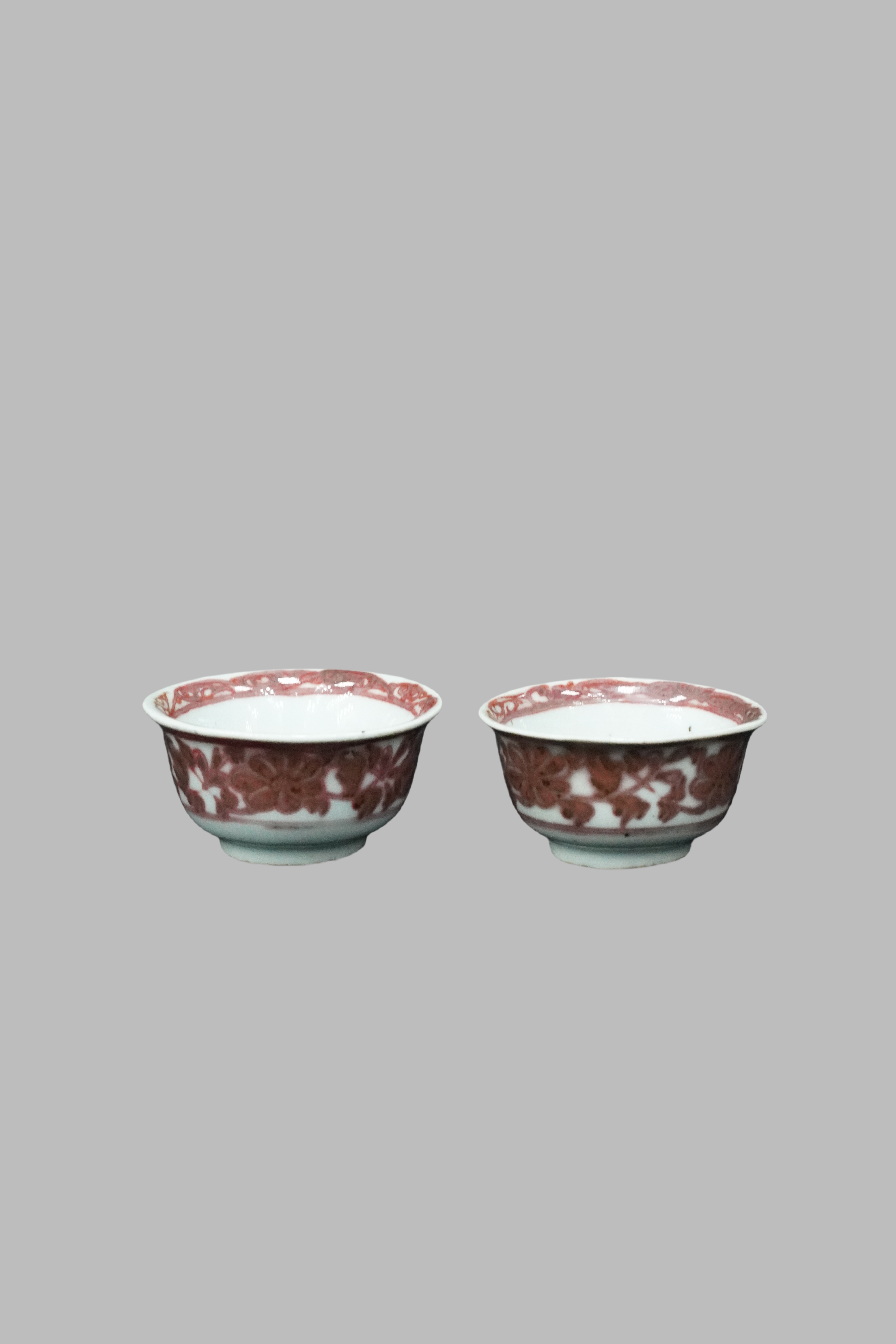
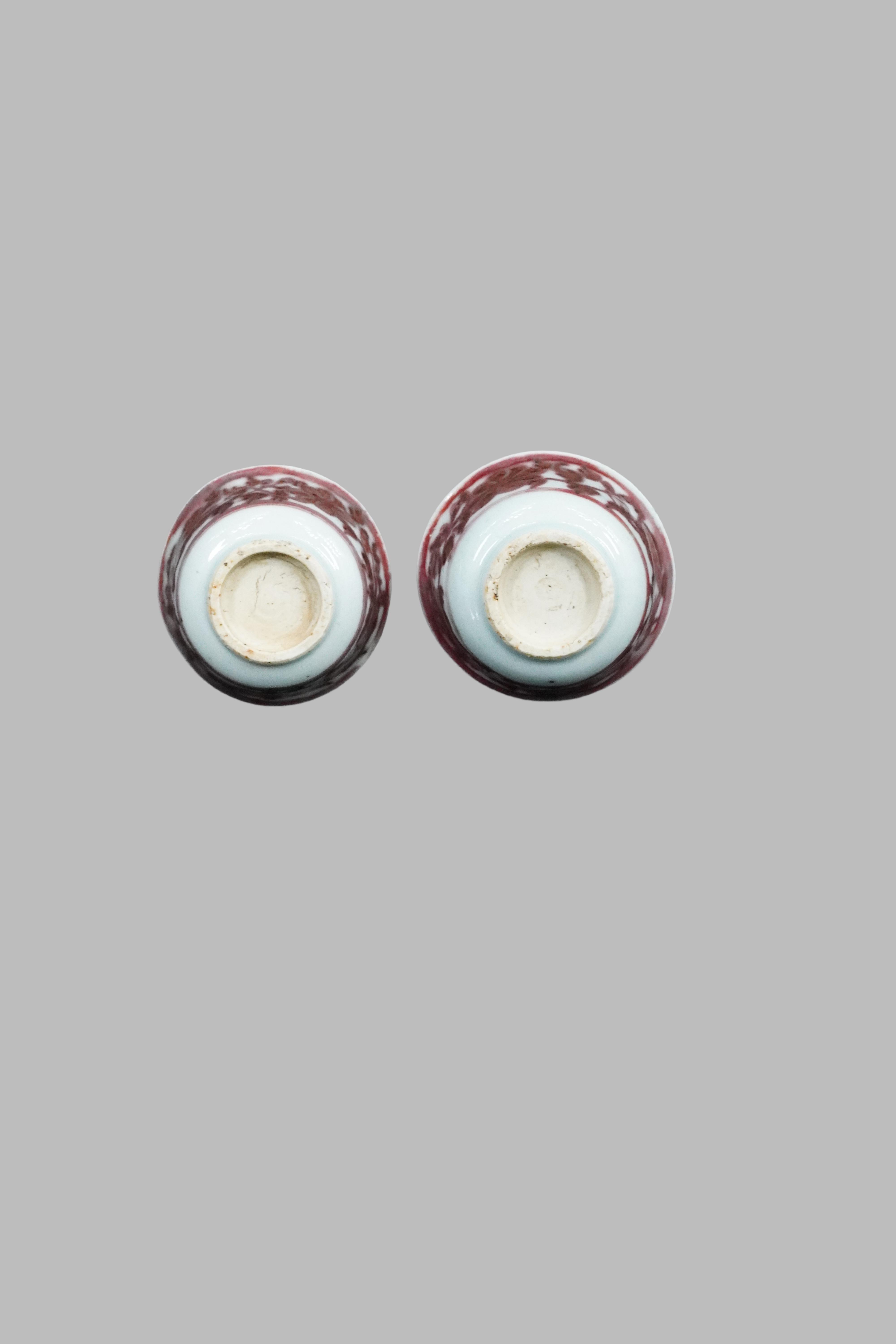
这对瓷器是明代釉里红缠枝花卉纹杯(一对),撇口深腹圈足杯,是明代中晚期常见的日用茶具/酒具,器型规整,胎体略显厚重(明中晚期民窑胎质不及明初细腻,但比元代更规整)。采用釉里红工艺一一以铜红料在釉下绘制纹饰,经高温烧制,发色呈"暗红/酱红”(这一时期釉里红发色稳定性提升,虽不及清代鲜亮,但已摆脱元代的晕散缺陷);釉面白中泛青,圈足露胎处呈“糯米白”反映了明中晚期釉里红从“初创” 到"成熟” 的工艺转变,是明代彩瓷发展的重要标本。
This pair of porcelain cups, decorated with the underglaze red interlocking floral motif, dates from the Ming Dynasty. Each cup has a flared mouth, deep belly and ring foot, a typical form of daily-use tea or wine vessels prevalent in the mid-to-late Ming period. The shape is well-proportioned, with a slightly thickened body — while the clay quality of civilian kiln wares in the mid-to-late Ming was less refined than that of the early Ming, it was more uniformly finished than Yuan Dynasty porcelain.Crafted using the underglaze red technique — where copper-red pigment is applied to the surface before glazing, followed by high-temperature firing — the glaze exhibits a dull red / maroon hue. During this period, the color stability of underglaze red saw significant improvement: though less vivid than Qing Dynasty examples, it overcame the serious color bleeding flaw that plagued Yuan Dynasty underglaze red wares.
The glaze surface presents a subtle bluish tint against the white base, and the exposed ring foot shows a glutinous rice-like white clay texture. These features reflect the technological transition of underglaze red from its experimental phase to maturity in the mid-to-late Ming, making this pair an important specimen for studying the development of Ming polychrome porcelain.
主题:杯身绘缠枝花卉纹(常见为缠枝牡丹/莲花),是明代中晚期流行的吉祥纹饰。寓意:缠枝纹象征“连绵不绝”,花卉寓意“富贵吉祥”,组合后传递“富贵绵长”的美好祈愿。风格:纹饰规整对称,线条简洁有力,符合明中晚期民窑“实用化、图案化” 的审美特点,区别于元代的粗犷豪放。
The bodies of the cups are decorated with the interlocking floral motif (typically featuring interlocking peonies or lotus flowers), an auspicious pattern prevalent in the mid-to-late Ming Dynasty.
The interlocking floral pattern symbolizes "endless continuity," while the flowers connote "prosperity and good fortune." Together, the design conveys the heartfelt wish for "everlasting prosperity."
Style: the motifs are neatly arranged and symmetrical, with concise yet powerful lines. This design conforms to the practical and stylized aesthetic characteristics of civilian kiln wares in the mid-to-late Ming Dynasty, standing in distinct contrast to the bold and unrestrained style of the Yuan Dynasty.