
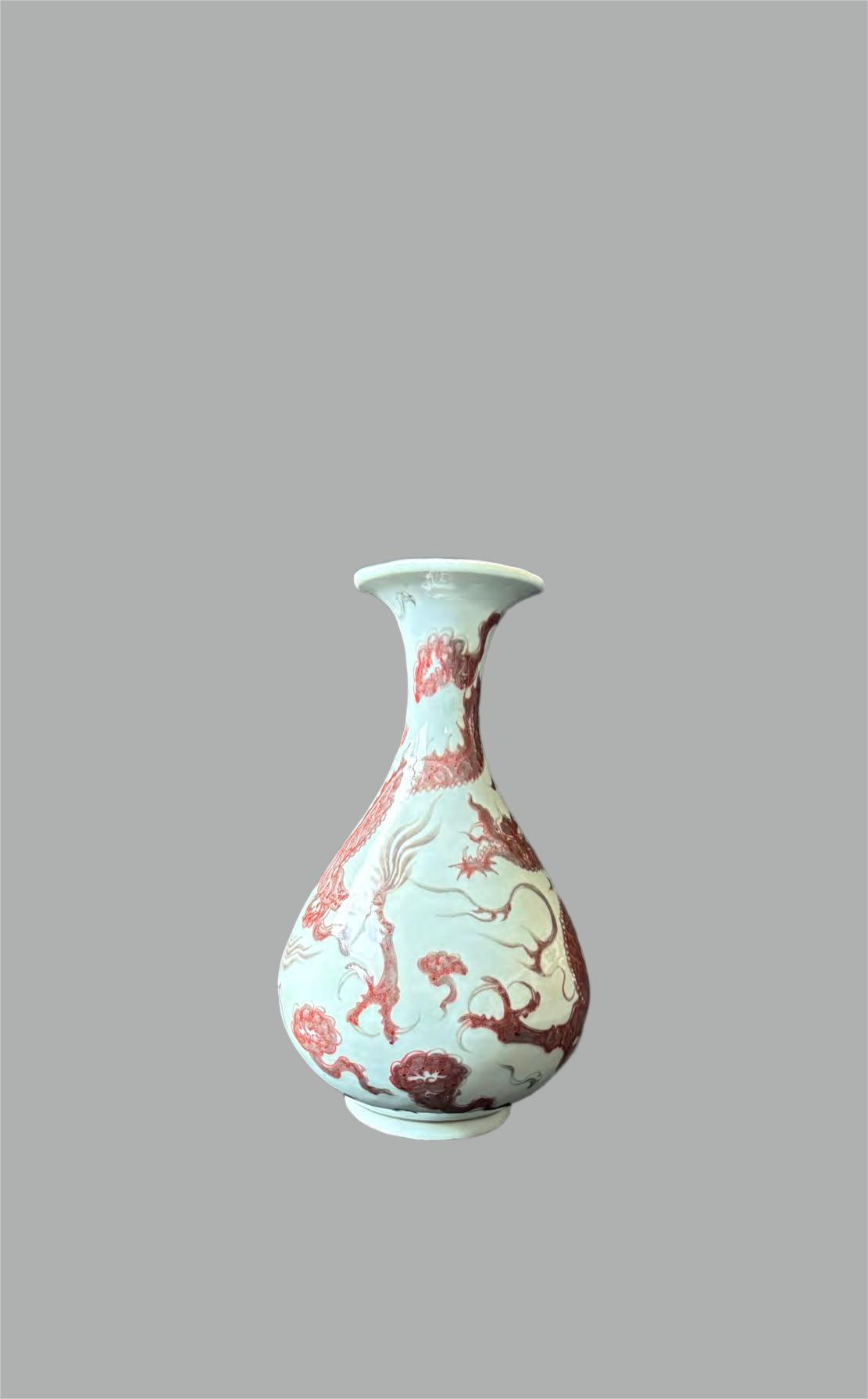
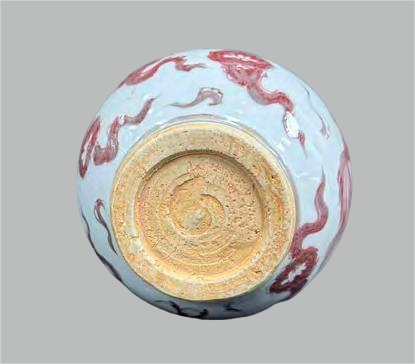
器型为撇口、细颈、垂腹(腹部呈水滴状)、圈足外撇,整体线条由柔和的S曲线构成,造型修长秀雅;玉壶春瓶最初是宋代酒器,元代演变为陈设瓷,胎体相对厚重,圈足修足多带“火石红”特征(底足露胎处的红褐色痕迹);此瓶尺寸通常在20-30cm之间,是元代釉里红器中较常见的器型之一。
It has a shape featuring a flared mouth, a slender neck, a drooping belly (the belly is teardrop-shaped), and an outward-flaring ring foot. The overall lines consist of soft "S"-shaped curves, giving it a slender and elegant appearance.The jade pot spring vase originally served as a wine vessel in the Song Dynasty; in the Yuan Dynasty, it evolved into a decorative porcelain piece. Its body is relatively thick, and the finishing of the ring foot is mostly characterized by "fire-red" (a reddish-brown mark on the exposed part of the base where the glaze is absent).
采用釉里红工艺(以铜红料在胎上绘画,罩透明釉后高温烧制),发色呈典型的元代"红中泛紫/晕散”特征(因当时烧造技术限制,铜红料发色难以精准控制);主体纹饰是单龙穿云纹:龙纹矫健凶猛(元代龙纹典型风格),龙爪张弛有力,间饰祥云纹,线条粗犷奔放;辅助纹饰通常在口沿、颈部搭配卷草纹/莲瓣纹(此瓶口沿处可见简化边饰)龙纹是皇权与威严的象征,搭配祥云纹,寓意皇权稳固、祥瑞高升;釉里红在元代属高端工艺,此类器物多为宫廷或贵族陈设用瓷,体现身份等
It adopts the underglaze red technique — pigments made of copper red are painted on the porcelain body, which is then covered with a transparent glaze and fired at high temperatures. The color presents the typical Yuan Dynasty characteristic of "red with a purple tint / blurring" (due to limitations in firing technology at that time, it was difficult to precisely control the color development of copper red pigments).
Main decorative pattern: single-dragon-through-clouds pattern. The dragon is depicted in a vigorous and fierce manner (a typical style of Yuan Dynasty dragon patterns), with its claws stretched powerfully. Auspicious cloud patterns are interspersed between the dragon's form, and the lines are bold and unrestrained.Auxiliary decorative patterns: usually, scroll patterns or lotus petal patterns are used on the rim and neck (simplified border decorations can be seen on the rim of this vase).The dragon pattern is a symbol of imperial power and majesty. When paired with auspicious cloud patterns, it implies "stable imperial authority and rising auspiciousness."Underglaze red was a high-end craftsmanship in the Yuan Dynasty. Porcelain wares of this type were mostly used as decorative pieces for the imperial court or nobles, reflecting the owner's social status and rank.