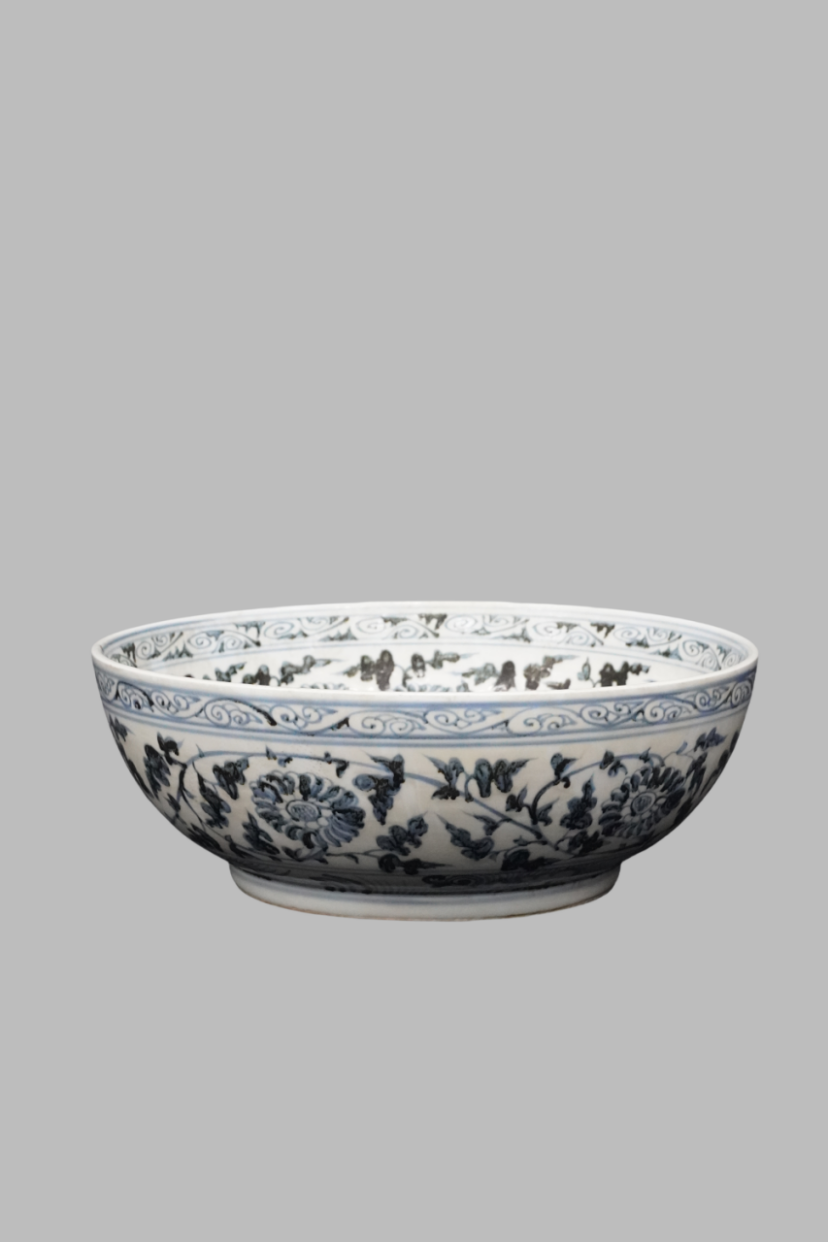
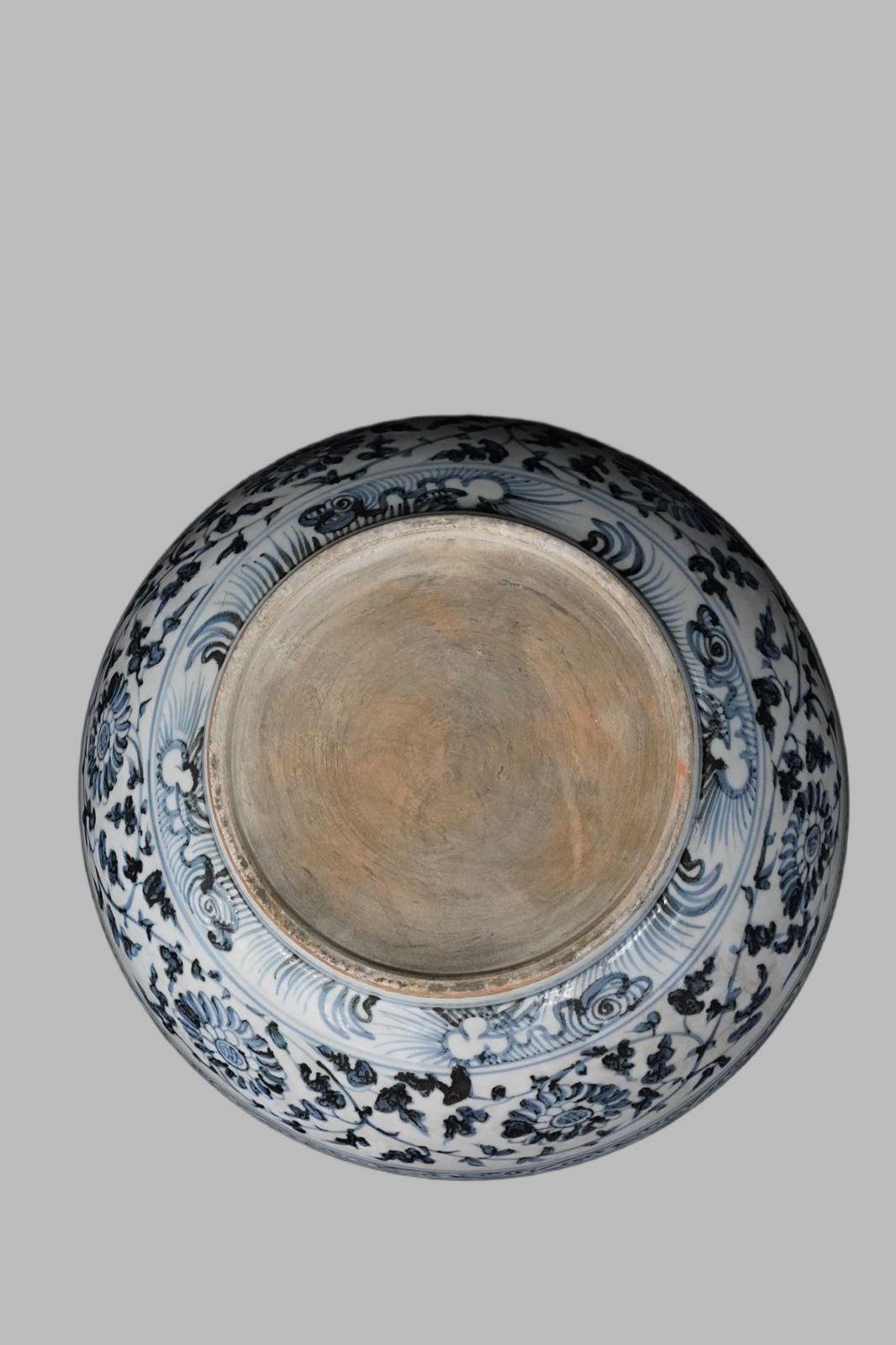
这件是明洪武青花缠枝牡丹纹大碗,洪武朝是明代青花的“奠基期”,敞口深腹圈足大碗,是洪武朝典型的大型日用/陈设器;胎体厚重(洪武瓷胎质较粗,呈"灰白胎”),圈足露胎处有“火石红”(胎土含铁量高,烧制后自然泛出的红褐色);釉面白中泛青,釉层较厚。明代青花的奠基标本:反映了洪武朝从“元青花”向“明青花”的工艺转型,是明代青花发展的起点。
This large blue and white bowl is from the Hongwu period of the Ming Dynasty, marked with an open mouth, deep belly, and ring foot. It served as a classic large-scale daily-use or display vessel of the Hongwu reign.
Its body is thick and heavy (Hongwu porcelain has a relatively coarse "grayish-white body"), and there is "orange-red fire stain" at the unglazed part of the ring foot (a reddish-brown discoloration naturally formed after firing due to the high iron content in the clay). The glaze surface is bluish-white with a relatively thick glaze layer.
It is a foundational specimen of Ming Dynasty blue-and-white porcelain: it reflects the technological transformation from "Yuan blue-and-white" to "Ming blue-and-white" during the Hongwu period, and serves as the starting point for the development of blue-and-white porcelain in the Ming Dynasty.
It reflects the technological transformation from "Yuan blue-and-white" to "Ming blue-and-white" during the Hongwu period, and serves as the starting point for the development of blue-and-white porcelain in the Ming Dynasty.
主题:碗身绘缠枝牡丹纹(外壁)+云气纹(内壁),是洪武朝流行的吉祥纹饰。
寓意:牡丹象征“富贵”,缠枝纹寓意“连绵不绝”,云气纹代表“祥瑞”,整体传递“富贵吉祥、福运绵长”的祈愿。
风格:纹饰粗犷豪放一- 牡丹花瓣饱满、线条刚劲,布局疏朗(区别于后世青花的精细规整),体现了洪武朝“尚质朴、重气势”的审美。
Theme: the exterior of the bowl features interlocking peony patterns, while the interior is decorated with cloud patterns — both popular auspicious motifs during the Hongwu period.
Meaning: peonies symbolize "wealth and nobility," interlocking branch patterns imply "endlessness and continuity," and cloud patterns represent "auspicious omens." Overall, it conveys wishes for "wealth and auspiciousness, as well as lasting good fortune."
Style: the decorative patterns are bold and unrestrained — the peony petals are plump and the lines are vigorous, with a sparse composition (distinguished from the delicate and regular blue-and-white patterns of later dynasties), reflecting the Hongwu era's aesthetic of "valuing simplicity and emphasizing momentum."